
 Podcast

National Press UK
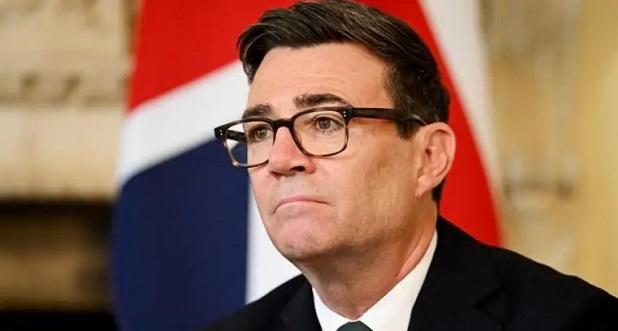
Britain—Prime Minister Andy Burnham is signalling a more assertive British approach to the Israeli-Palestinian conflict, with new restrictions on trade with Israeli settlements in the occupied West Bank marking one of the clearest foreign-policy departures from the government of his predecessor, Sir Keir Starmer.
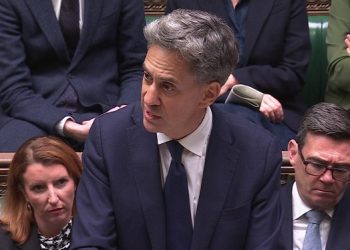
Foreign Secretary Ed Miliband announced the measures in the House of Commons on Tuesday, with Burnham sitting alongside him, as Britain coordinated action with 11 other countries, including France and Canada.
The UK, France, and Canada have committed to bringing forward national measures banning trade in settlement goods, while the wider group has said it will introduce, support, or actively consider national or European restrictions according to domestic procedures. The British government says the measures target settlements rather than trade with Israel as a whole.
The move comes almost a year after Britain formally recognised a Palestinian state and reflects Burnham’s determination to present his government as willing to use economic and diplomatic pressure where it believes Israeli policy threatens the prospects of a two-state solution.
That approach is particularly evident over the E1 settlement project. Britain and a broad coalition of international partners have warned that development there would threaten the territorial continuity of a future Palestinian state. Burnham had already described Israel’s latest move on E1 as unacceptable during talks with French President Emmanuel Macron last week.
For Miliband, the argument is that diplomatic condemnation without action is no longer sufficient. Addressing Parliament, he presented the new policy as an attempt to preserve the possibility of Israel and a viable Palestinian state existing alongside one another in peace and security.
The initiative also demonstrates Britain’s attempt to build a coordinated international response rather than act alone. Canada, Denmark, Finland, France, Iceland, Ireland, Norway, Poland, Portugal, Spain, Sweden, and the UK signed Tuesday’s declaration, which warned of rapidly deteriorating conditions in the West Bank amid settlement expansion and unprecedented levels of settler violence.
A political calculation at home
The policy nevertheless carries significant domestic political risks.
Burnham inherited a Labour Party whose handling of Israel and Gaza had strained relations with parts of both Britain’s Muslim and Jewish communities. His government must now demonstrate that criticism of Israeli government policy and settlement activity can be pursued without contributing to hostility towards British Jews.
Miliband, who is Jewish, sought to draw that distinction explicitly in Parliament. He condemned antisemitism while arguing that opposition to settlement expansion and settler violence was consistent with supporting Israel’s security and right to exist.
That distinction has not satisfied all critics. Conservative leader Kemi Badenoch has argued that Labour’s approach risks contributing to an increasingly hostile environment for British Jews, while Chief Rabbi Sir Ephraim Mirvis has expressed deep concern about the government’s direction.
For Burnham, the challenge is therefore twofold: convincing international partners that Britain is prepared to exert meaningful pressure in defence of a two-state solution while reassuring Jewish communities at home that the government’s dispute is with particular Israeli policies, not with Israel’s existence or British Jews.
The decision also fits into a trajectory that predates Burnham’s premiership. In June, Britain and several allies imposed coordinated sanctions on networks accused of financing or enabling extremist settler violence, while UK guidance was strengthened to advise British businesses against economic activity in Israeli settlements.
What has changed is the political emphasis.
Burnham is attempting to demonstrate that Britain retains the capacity to influence events through coordinated diplomacy and economic measures. Whether the restrictions materially alter Israeli policy remains uncertain. But politically, their message is already clear: on Israel and the occupied Palestinian territories, the new prime minister is prepared to move further—and more visibly—than the government he replaced.















 Edinburgh,UK
 info@uknepalpress.com
Discussion about this post